Best Smart Home Devices for Apartments & Renters (2026): No-Drill, Deposit-Safe Picks

You do not need to own a house to live in a smart home. The best smart home devices for renters in 2026 are the ones that install in minutes, stick on or plug in instead of screwing in, and come off cleanly when your lease ends — battery video doorbells, smart plugs, retrofit smart locks that fit over your existing deadbolt, adhesive leak sensors, smart bulbs, and portable indoor cameras. Everything in this guide follows three renter rules: no drilling, no rewiring, and nothing that cannot be undone on moving day.
In our research we focused on devices widely available in the US that work over ordinary apartment Wi-Fi and have a solid reliability record in owner feedback. Prices below are approximate US street prices — check current pricing at major US retailers before you buy.
What Makes a Smart Device Renter-Friendly?
Not every “easy install” device is actually safe for a lease. Before our picks, here is the filter we used — it is worth applying to anything you are considering.
The three renter rules
- No permanent changes. No new holes in walls or door frames, no swapped-out hardware, no hardwiring. Adhesive mounts, over-the-door hooks, and plug-in devices are in; hardwired doorbells and wired thermostats are out unless your landlord agrees in writing.
- Everything leaves with you. A renter-friendly device can be packed in a box on moving day and reused in the next apartment. If it has to stay behind, it is usually not worth buying.
- Your original hardware stays intact. The best renter smart locks, for example, fit over the deadbolt you already have, so your landlord’s key still works and you can restore the door to its original state in minutes.
Set a realistic budget
A solid starter setup — a battery doorbell, two smart plugs, a couple of smart bulbs, and a leak sensor or two — typically runs roughly $150 to $300 in total. You do not have to buy it all at once; plugs and bulbs are the cheapest way to start.
Quick Picks: The Best Smart Home Devices for Renters
| Device | Why renters like it | Approx. price |
|---|---|---|
| Battery video doorbell | Adhesive or bracket mount, no doorbell wiring | $65–$200 |
| Retrofit smart lock | Fits over your existing deadbolt, key still works | $150–$280 |
| Smart plug | Plugs in anywhere, controls lamps and fans | $10–$25 each |
| Smart bulbs | Screw in, no wiring, take them when you move | $10–$20 each |
| Water leak sensor | Just place it — catches leaks before they cost you | $15–$35 each |
| Portable indoor camera | Sits on a shelf, moves room to room | $30–$100 |
Best Battery Video Doorbell for Renters
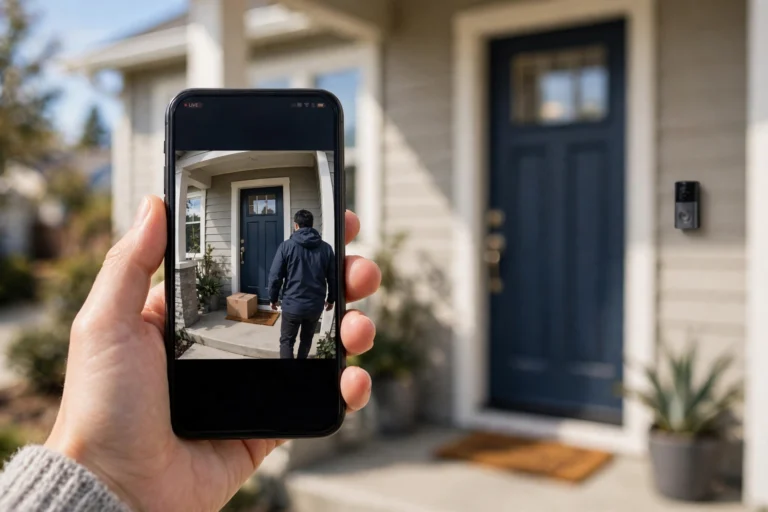
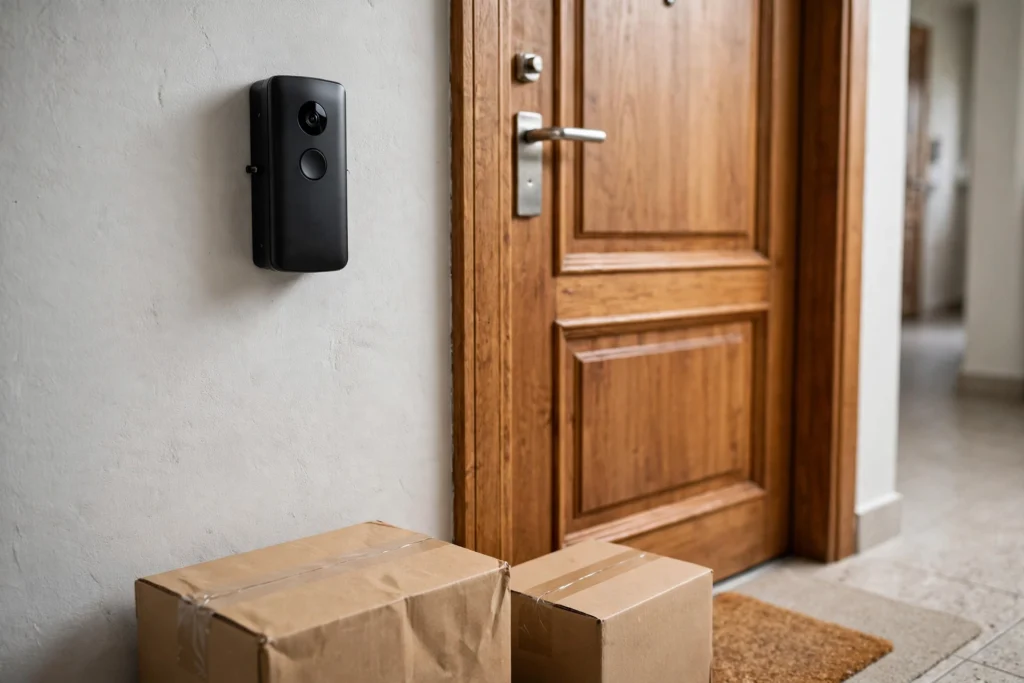
A video doorbell is the single most useful security upgrade for an apartment, and the battery-powered models are made for renters. They mount with an adhesive strip or a simple bracket on the door frame — no existing doorbell wiring required — and they run for weeks to months per charge depending on how much foot traffic your hallway gets.
In our research, the features that matter most for apartment living are a head-to-toe or wide field of view (packages left at your door are the main event), reliable motion alerts, and two-way talk so you can speak to couriers from work. Local-storage models and brands that include basic alerts without a monthly plan are popular with owners who want to avoid subscriptions; cloud plans typically add longer video history and smarter person/package detection for a few dollars a month.
Pros
- Installs in about 10 minutes with no tools in many cases
- Works even if your unit has no doorbell wiring at all
- Battery power means it moves with you to the next place
Cons
- Needs recharging every few weeks or months
- Hallway-facing doors can trigger frequent motion alerts — plan to tune sensitivity
- Some apartment buildings restrict door-mounted devices, so check your lease first
Best Renter-Friendly Smart Lock: Retrofit Models
A standard smart lock replaces your deadbolt — which most leases do not allow. Retrofit locks take a smarter approach: the motor unit clamps onto the inside of your existing deadbolt, turning the thumb-turn for you. From outside, the door looks completely unchanged, your landlord’s key still works, and when you move out you simply unclamp it.
Based on manufacturer specifications, the better retrofit models add auto-lock, guest codes or app-based access for friends and dog walkers, and door-sense features that tell you if the door was left ajar. Expect to pay roughly $150–$280. Battery life is usually several months on a set of AAs.
Pros
- No lock change — lease-safe in most cases and landlord key stays valid
- Auto-lock ends the “did I lock up?” worry
- Removes in minutes when you move
Cons
- Only works if your existing deadbolt is a compatible single-cylinder model
- The indoor unit is bulkier than a standard thumb-turn
- Wi-Fi features on some models require a small plug-in bridge nearby
Best Smart Plugs for Apartments
If you buy one renter device, make it smart plugs. They need zero installation — plug one into any outlet, plug a lamp, fan, or coffee maker into it, and you have scheduling, voice control, and away-from-home control for roughly $10–$25 per plug. In owner feedback, the most appreciated features are energy monitoring (which shows what an appliance actually costs to run) and Matter support, which keeps the plug working across Alexa, Google Home, and Apple Home.
Renters use them to make a basic lamp feel like smart lighting, run a window fan on a schedule, and confirm the iron really is off. Buy multi-packs for the best per-plug price.
Pros
- Cheapest, fastest smart home upgrade there is
- No tools, no permission needed, fully portable
- Energy-monitoring models help trim your power bill
Cons
- Only controls simple on/off appliances — useless for devices with electronic standby switches
- Bulky models can block the second outlet
- Cheap no-name plugs have spottier app support — stick to known brands
Best Smart Bulbs for Renters
Smart bulbs screw into the lamps and fixtures you already have, which makes them a perfect apartment upgrade: dimming, warm-to-cool white, color scenes, and schedules, all without touching a wire. A single color bulb is typically $10–$20, and starter kits bring the per-bulb cost down.
One honest warning from owner experience: smart bulbs need constant power, so a wall switch turned off kills them. In rentals — where you cannot swap the switch — leave it on and control the bulb by app or voice, or add a cheap adhesive switch cover. Thread- and Matter-based bulbs also respond faster than older Bluetooth-only models.
Pros
- Instant smart lighting with zero installation
- Take every bulb with you when you move
- Great for renters who cannot change light switches or fixtures
Cons
- Useless when someone turns the wall switch off
- Some brands need a hub for full features — check before buying
- Color bulbs cost more; white-only bulbs are fine for most rooms
Best Leak Sensors for Apartments
Ask any landlord what they fear most, and it is water damage. A smart leak sensor is a small puck you simply place on the floor — under the kitchen sink, beside the washing machine, behind the toilet — and it alerts your phone the moment it touches water. No installation at all. Most cost $15–$35 and run a year or more on a coin battery.
For renters this is cheap insurance twice over: it protects the unit (your landlord will love that you have them), and it protects your deposit and your belongings if the unit above you leaks. Models with a loud built-in alarm are worth it, because they alert you even if your phone is on silent. Note that most basic sensors only detect and alert — models that automatically shut off the water exist, but they require plumbing work that renters should not do.
Pros
- Literally zero installation — put it down and it works
- Early warning can save your deposit and your furniture
- One of the few devices landlords actively approve of
Cons
- Detect-only: you still have to turn the water off yourself
- Wi-Fi models drain batteries faster than hub-based ones
- A single sensor only covers the spot it sits in — budget for 2–3
Best Portable Indoor Camera for Renters
For pets, packages inside the door, or peace of mind when you travel, a small plug-in indoor camera is the renter standard. It sits on a shelf — no mount required — and unplugs when you move. Good ones run $30–$100.
Choose a camera with local microSD storage to avoid another subscription, and look for a physical privacy shutter. Point it at your entry door, and if you have roommates, agree on placement — some leases and state laws cover recording shared areas.
Pros
- Shelf placement — no mounting, no holes
- Pet monitoring and travel check-ins are genuinely useful
- Local-storage models avoid monthly fees
Cons
- Cloud AI features usually sit behind a subscription
- Roommates and guests may not love it — set expectations
- Needs to be near an outlet for power
Before You Buy: Landlord Permission and Apartment Wi-Fi
Do you need your landlord’s permission?
For plug-in and adhesive devices — plugs, bulbs, sensors, shelf cameras — generally no permission is needed, because you are not modifying the unit. For anything that attaches to the door or door frame, including retrofit locks and doorbell mounts, a quick email to your landlord or property manager is smart. In our experience reading lease guidance, most landlords say yes to a retrofit lock precisely because their key keeps working and nothing is altered. Whatever the answer, get it in writing, and keep the original parts for anything you temporarily remove.
Wi-Fi tips for apartments
Apartment Wi-Fi is crowded Wi-Fi — dozens of neighboring networks competing for the same airwaves. A few habits help:
- Use the 2.4 GHz band for smart devices. Most plugs, bulbs, and sensors are 2.4 GHz only anyway, and it reaches through walls better than 5 GHz.
- Count your devices. Building-provided routers often struggle past 20–30 connected devices; if your smart home keeps dropping offline, the router is usually the bottleneck.
- Place the router centrally and high up, away from the microwave if you can.
- Prefer Matter and Thread where possible. Thread devices form their own mesh and barely touch your Wi-Fi at all, which matters in a small unit full of gadgets.
How to Choose: A Simple Renter Checklist
Work through these five questions and you will avoid almost every bad purchase:
- Can I remove it in under 10 minutes? If not, it is probably not renter-friendly.
- Does it need a hub? Hub-free Wi-Fi or Matter devices are simpler in a rental; hub systems shine later in a house.
- What does the subscription really cost per year? A $60 doorbell with a $50/year plan costs more over a lease than a $100 doorbell without one.
- Will it work in my next apartment too? Standard sizes and platform-agnostic (Matter) devices survive a move best.
- Does it solve a problem I actually have? Package anxiety → doorbell. Forgotten lights → plugs and bulbs. Leak worry → sensors. Buy for the problem, not the gadget.
Frequently Asked Questions
Can my landlord stop me from using smart home devices?
For devices that do not modify the unit — plugs, bulbs, sensors, plug-in cameras — landlords generally have no grounds to object. Anything that changes locks, wiring, or the door itself usually needs written permission, and some leases specifically restrict door-mounted doorbells. When in doubt, ask by email so the answer is documented.
What is the best first smart device for a renter?
A smart plug. It costs the least, installs in a minute, proves the concept on a lamp or fan you already own, and still has a job in every future home. A battery video doorbell is the best second purchase if package security is your main concern.
Will smart devices work if my apartment Wi-Fi is bad?
Mostly yes, if you stick to the 2.4 GHz band and keep the device count reasonable. If things are unreliable, Thread-based devices (which need a Thread border router such as a compatible smart speaker or streaming box) bypass Wi-Fi congestion almost entirely, because they talk to each other in a mesh.
Can I take my smart devices when I move?
Yes — that is the whole point of this list. Every pick here is adhesive, plug-in, screw-in, or clamp-on, and can be removed without evidence it was ever there. Save the original adhesive strips’ backing and any parts you removed, like a doorbell’s mounting plate screws, in a labeled bag.
Do smart locks work if my landlord needs access?
Retrofit locks keep the original key cylinder, so your landlord’s key works exactly as before — one reason landlords tend to approve them. Just make sure any auto-lock settings do not fight with building rules about access for maintenance and emergencies.
Related Guides
Keep building your renter-friendly setup with these guides from SMT Electro:
- 10 Best Smart Home Devices — our overall beginner-friendly picks
- Best Smart Video Doorbells for Home Security — the full doorbell comparison
- 10 Best Smart Door Locks for Home Security — including retrofit options renters can use
- Best Smart Plugs — with energy-monitoring and Matter picks
- Best Smart Water Leak Detectors — protect your deposit and your downstairs neighbor
Prices in this guide are approximate US prices based on manufacturer list prices and typical retail pricing at the time of writing, and they change frequently — check current prices at major US retailers before buying. This guide will be updated as new renter-friendly models arrive.