
Best Portable Power Stations for Home Backup (2026): Sized for Fridges, CPAPs and Real Outages
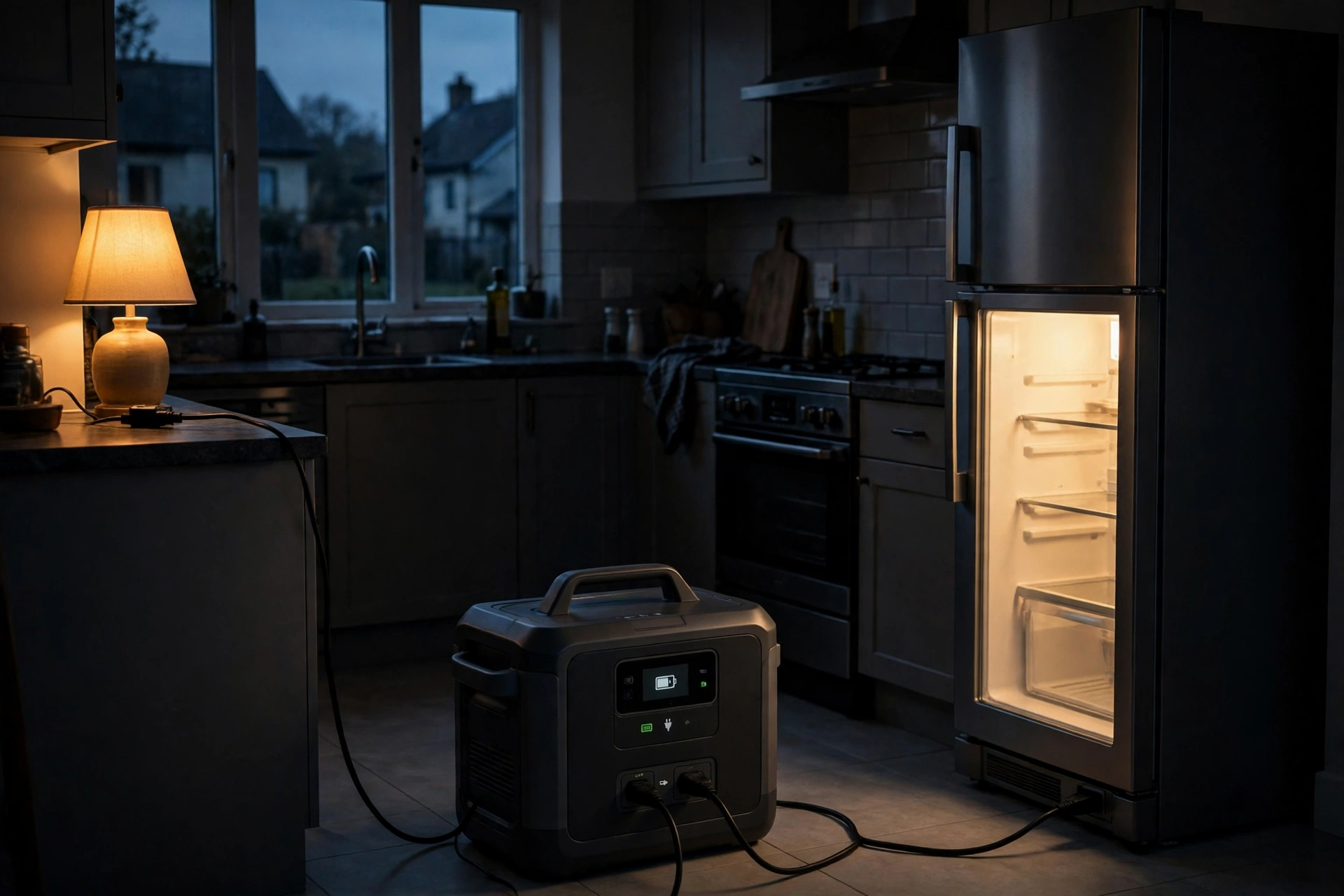
For home backup, the best portable power station is not the biggest one — it is the one sized to your actual outage list. For most homes that means a medium ~1,000Wh unit (our pick: EcoFlow DELTA 3 Plus) that keeps a fridge cold, a CPAP running, the Wi-Fi on and the lights lit through a typical overnight outage. Smaller homes and apartment dwellers can step down to a ~300Wh unit (Jackery Explorer 300 Plus) for communications and medical basics; homes facing multi-day storm outages should step up to a ~2,000Wh unit (Bluetti AC200L) or a 3,600Wh-class machine. Below we do the sizing maths openly — watts per appliance, usable watt-hours, worked runtime examples — so you can check our picks against your own fridge and your own outage history.
Home Backup Is a Different Job From Camping
Our general portable power station guide covers camping, RVs and job sites too. This guide is narrower on purpose, because backup power at home changes what matters:
- The fridge is the mission. Food safety, not entertainment, is what most households are protecting; everything else is secondary loads ranked around it.
- Runtime beats portability. A camping station gets carried daily; a backup station twice a year. Weight matters less than watt-hours per dollar.
- Recharging mid-outage matters. Solar input and fast wall charging decide whether the station is a one-night battery or a multi-day system.
- Indoor safety is non-negotiable. The station will run in your kitchen at 2 a.m. — no exhaust, no fuel. That is the entire advantage over a petrol generator.
The Only Maths You Need: Watts, Watt-Hours, and the 0.85 Rule
Two numbers on every spec sheet decide everything:
- Watts (W) — output. What the station can run at once. A 1,800W station can start and run a fridge, a microwave, or a kettle — but check surge: fridge compressors briefly draw several times their running watts when starting.
- Watt-hours (Wh) — capacity. How long it can run things. Think of watts as the size of the tap and watt-hours as the size of the tank.
Then apply the 0.85 rule: conversion losses mean you can only use roughly 80–85% of the printed capacity through the AC outlets. Manufacturers’ own runtime formulas land in the same place — some are stricter, closer to 0.77–0.80 — so plan with 0.85 and be pleasantly surprised, never the reverse.
Runtime formula: (Capacity in Wh × 0.85) ÷ appliance watts = hours of runtime.
What your essentials actually draw
| Appliance | Typical draw | Notes |
|---|---|---|
| Full-size fridge | 100–200W while running, ~1–1.5 kWh/day | Cycles on/off; average draw is what eats capacity |
| Chest freezer | 80–150W running | Keeps food frozen 24h+ unopened with no power at all |
| CPAP | 30–60W (90W+ with heated humidifier) | Turn the humidifier/heat off to roughly halve consumption |
| Wi-Fi router + modem | 10–20W combined | The cheapest load you own — always worth powering |
| LED lighting (per bulb) | 8–12W | A whole room’s light for the cost of one old bulb |
| Phone charging | 10–20W | Trivial; days of charges per 100Wh |
| Laptop | 45–90W | While working; far less idle |
| Microwave | 1,000–1,500W | Short bursts — an output (W) question, not a capacity problem |
| Space heater | ~1,500W | Do not plan on this; it empties a 1kWh station in ~35 minutes |
Worked example: one overnight outage, medium station
Take the classic load set: fridge, CPAP, router, and lights. Do not size from the fridge’s running watts — size from its energy label. A modern efficient fridge using 1–1.5 kWh/day consumes roughly 500–750Wh across a 12-hour night (the compressor rests much of the night in a cool, unopened fridge). Add the rest:
- CPAP at 40W × 8h = 320Wh. Router at 15W × 12h = 180Wh. Two LED bulbs, 20W × 5h = 100Wh.
- Total raw demand: roughly 1,100–1,350Wh — about 950–1,150Wh of station capacity once the 0.85 rule is applied.
That is right at the edge of a 1,024Wh station and comfortable on a 2,048Wh one — and it is the honest shape of home backup: a 1kWh station covers a careful household overnight (CPAP humidifier off, fridge kept shut); a 2kWh station covers it without the careful part.
Our Picks, Sized Small / Medium / Large
Small: Jackery Explorer 300 Plus (~288Wh) — communications and one medical device
A ~300Wh station is not fridge backup; it is continuity backup. At roughly $200–$300, the Explorer 300 Plus (288Wh, LiFePO4) runs a router for close to a day, charges phones for a weekend, powers LED lights for evenings, or runs a CPAP (humidifier off, ideally via a DC converter, which owners report is noticeably more efficient than the AC outlets) for about one night. For apartments, short outages, and tight budgets, that is a rational purchase — as long as you buy it with clear eyes about the fridge.
Pros
- Light enough to move room to room; genuinely portable in a blackout
- LiFePO4 battery at an entry price
- Covers the “stay connected and informed” tier completely
Cons
- Cannot meaningfully protect a fridge
- One CPAP night, not two
- Low AC output limits appliance choices
Medium: EcoFlow DELTA 3 Plus (1,024Wh) — the default home-backup size
The DELTA 3 Plus is the class benchmark for this job: 1,024Wh of LiFePO4 capacity, 1,800W AC output (enough for a fridge’s start surge and a microwave), expansion options with EcoFlow extra batteries if outages outgrow it, and — the feature owners praise most in multi-day events — very fast wall recharging (a full charge in under an hour per EcoFlow’s specifications), so a brief return of grid power fully refills it. A fast UPS-style switchover on this class of unit also makes it a tidy always-on backup for a router and desktop. List price sits around $799, with street prices frequently lower.
Pros
- The right size for the worked example above, without paying for 2kWh
- Fast recharge turns short grid returns into full refills
- Expandable later instead of replaced later
Cons
- Fridge-plus-everything for a full day-plus outage still stretches it
- Expansion batteries are EcoFlow-only and add real cost
- At ~27 lb it is luggable, not handy
Large: Bluetti AC200L (2,048Wh) — multi-appliance, longer outages
Step up to ~2kWh and the maths relaxes: the AC200L’s 2,048Wh and 2,400W output run the fridge, freezer, CPAP, router and lights together through a day-long outage, handle a microwave or kettle without arithmetic anxiety, and accept generous solar input for multi-day events. It is expandable with Bluetti batteries if you later go further. Expect roughly $999–$1,299 depending on sales, and roughly 60 lb — this lives where it will be used, not in a cupboard upstairs.
Pros
- Two days of careful essentials, one day of comfortable ones, on a charge
- Output headroom for power tools and kitchen appliances
- Strong solar input for genuine multi-day resilience
Cons
- Heavy — plan its home before the outage, not during
- Overkill for apartments and short-outage regions
- Expansion locks you into Bluetti’s batteries
A note on the class above: 3,600Wh stations (EcoFlow DELTA Pro class and rivals) exist for near-whole-home ambitions, especially with a transfer switch (below). They are excellent machines, but at roughly $2,000+ and ~100 lb they answer a different question than most households are asking.
Solar Recharging During an Outage: Realistic Numbers
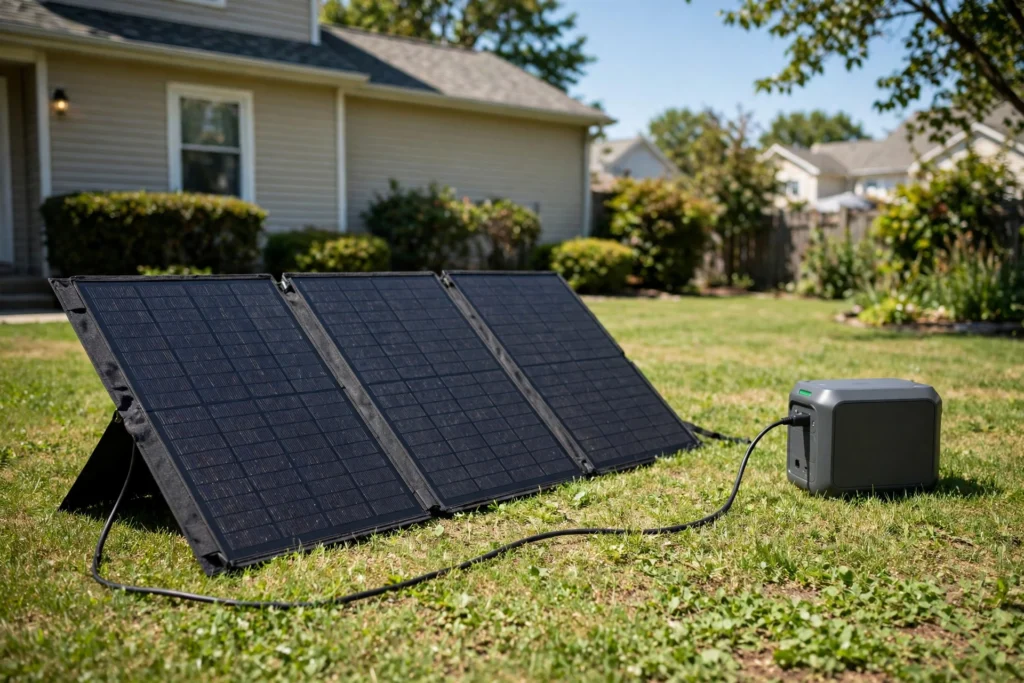
A power station plus panels is often sold as infinite power. It is better described as a daily budget. A 400W panel array in decent sun realistically delivers 250–320W through the middle of the day and roughly 1.2–1.6 kWh across a good day — enough to refill a medium station daily in fair weather. Cloudy winter days can halve that. From owner experience: size panels toward the station’s maximum solar input if multi-day outages are your scenario (undersized panels are the most common regret), prefer rigid panels per dollar if you have a yard or balcony, and reposition panels once or twice toward the sun — during an outage, you are home anyway.
Plugging the House In: Extension Cords vs Transfer Switches
Extension cords are the default and are fine: station in a central spot, heavy-duty cords to the fridge and the bedroom. Keep cords short, never run them under rugs, and never use a “suicide cord” (male-to-male) to backfeed a wall outlet — it is dangerous and illegal in many places.
A manual transfer switch with an inlet box is the grown-up upgrade once you reach the large class: an electrician installs a small panel that lets the station safely power selected circuits (furnace blower, well or sump pump where compatible, kitchen outlets, lights) through the house wiring, with the grid positively disconnected. Manufacturers also sell proprietary whole-home panels for their big stations. Budget for professional installation — figures vary widely by region and panel, so get local quotes — and note that most portable stations output 120V only, so 240V loads (most well pumps, electric dryers, central AC) stay off the list unless you step into dual-unit or 240V-capable systems.
Indoor Safety Rules That Are Not Optional
- No carbon monoxide — the headline benefit. Unlike a petrol generator, a power station can run in the kitchen. Never let anyone talk you into running a combustion generator indoors or in a garage “just this once”; that is how outage fatalities happen.
- Keep vents clear and the unit off soft furnishings while charging or under heavy load; stations move air to cool themselves.
- Prefer LiFePO4 (all three picks): it is the most thermally stable lithium chemistry and is rated for thousands of cycles — 3,000–6,000+ to 80% capacity depending on model — versus a few hundred for older chemistries.
- Mind charging temperatures. Most lithium stations should not be charged below freezing; bring a garage-stored unit indoors to warm up first.
- Store it ready. Follow the maker’s storage guidance (commonly a partial charge, topped up every few months) so the battery you need in October is not the battery that died in March.
How to Choose the Right Size
- Write your outage list — the five things that must run, in order. For most homes: fridge, CPAP/medical, router/phones, lights, then comfort.
- Total the watt-hours for your realistic outage length (use the table and formula above; most US outages are under 12 hours, storm regions should plan 48–72).
- Check watts as well as watt-hours — the largest single load (plus fridge start surge) must fit under the station’s output and surge ratings.
- Decide your recharge plan: wall-only is fine for overnight outages; solar input size matters the moment you plan past day two.
- Buy the size above your maths if the budget allows one step — manufacturer capacities are best-case, appetites grow, and nobody in a blackout wishes they had bought the smaller battery.
Frequently Asked Questions
How big a power station do I need to run a refrigerator?
For overnight protection of a typical modern fridge alongside small essentials, ~1,000Wh is the sensible floor. For a full day or more of fridge duty, or an older, larger, less efficient fridge, plan on ~2,000Wh. The fridge’s own energy label (kWh per year) is the best input: divide by 365 for its real daily consumption, and size from that with the 0.85 rule rather than from the running-watts figure alone.
Can a portable power station run a CPAP all night?
Yes, easily at medium size and just about at small size — with conditions. A CPAP without heated humidification draws roughly 30–60W, so an 8-hour night needs about 240–480Wh of usable capacity. Turn off the heated humidifier and tube heating if your therapy allows (it can nearly double the draw), and use a DC converter where the CPAP maker offers one — owners consistently report meaningfully longer runtimes on DC because it skips a conversion step. If CPAP is medically critical, size up and keep a second night of reserve.
Is it safe to run a power station indoors overnight?
Yes — that is its core advantage over a generator: no exhaust, no carbon monoxide, no fuel indoors. Follow the basics: vents unobstructed, unit on a hard surface, nothing draped over it, and charge it in the living space rather than a freezing garage in winter. LiFePO4 models are the conservative choice for unattended indoor use.
Can a power station power my whole house?
Not in the way the phrase suggests. Even a 3,600Wh station holds a fraction of a typical home’s daily consumption (US homes average roughly 30 kWh/day). What the large class can do — especially through a transfer switch — is power a chosen panel of essential circuits for many hours: fridge, furnace blower, some lights and outlets. Size for circuits, not for the whole house, and the technology delivers exactly that.
How long will the battery last if it mostly sits in storage?
LiFePO4 chemistry is kind to stored equipment: rated cycle life runs into the thousands, and calendar ageing at partial charge is slow. Follow the manufacturer’s storage guidance — typically storing around half to three-quarters charged and topping up every 3–6 months — and a backup station should remain dependable for many years. The common failure story is not wear; it is a station stored empty and forgotten.
Related Guides
Round out your outage plan with these SMT Electro guides:
- Best Portable Power Stations — our general guide covering camping, RV and outdoor use too
- Best Smart Plugs — energy-monitoring plugs are the easy way to measure what your own fridge and appliances really draw before you size a station
- 10 Best Smart Home Devices — the rest of the resilient, outage-friendly smart home
Prices in this guide are approximate US prices based on manufacturer list prices and typical retail pricing at the time of writing; power station prices fluctuate sharply with sales and seasons. Runtime figures are estimates from manufacturer specifications and standard load assumptions — your appliances’ actual consumption, verified on their energy labels, should drive your final sizing. Check current pricing at major US retailers before buying.